Thursday, October 22, 2009

Serial Drivel: Someone new to take over for James C Cooper

I stumbled upon this post from Real Clear Markets via ZeroHedge. A quick aside: I have a love hate relationship with ZeroHedge. They produce some great research but they also engage in yellow journalism without real well thought out analysis as well. A la Hearst, this drives a lot of people to their website. For now the balance is well on the former but this link to RCM was clearly the latter.

The author of this piece is John Tamny. It took some extensive searching to find out who the author is. His signature says he is an economic adviser to two companies but not recognizing the companies, please forgive my ignorance, I continued looking about the intertubes. I found this:
Prior to his present work, Mr. Tamny worked at the Cato Institute, and before that in private wealth management for Credit Suisse and Goldman Sachs. Mr. Tamny received a BA in Government from the University of Texas at Austin, and an MBA from Vanderbilt University's Owen Graduate School of Management. He lives in Washington, D.C.

Now I have an MBA, so I definitely understand the value of the degree, but putting up an MBA grad with a Government undergrad versus a Nobel Prize winning economist, well... maybe he will be agreeing with Mr. Krugman.

1st the headline has Paul Krugman's name and the word myth. This immediately sends off warning bells in my head. I generally follow on economic matters, (not so much political)
Brad DeLong’s Krugman rule:


Rule #1. Paul Krugman is always right.
Rule #2. If you think Paul Krugman is wrong, see Rule #1

Here is an excerpt from the article.
As Krugman put it in the
New York Times, "The truth is that the falling dollar is good news." Krugman's reasoning here is that a weak dollar makes it easier for U.S. companies to export. A nice thought at first glance, but what Krugman ignores is that we can't export unless we're importing, and a weak dollar makes imports more expensive. Trade always balances.

Supposedly, according to John's logic, trade always balances. He seems to posit that imports and exports form an identity, similarly to the idea that National Savings must equal Investment and Net Capital Outflow. I couldn't find any literature anywhere that states this is so, perhaps it is a black swan.

Let's examine this a little further. Let's imagine a steel conglomerate who mines its own ore, processes it and then sells it to the highest bidder. A falling dollar makes this conglomerate's goods cheaper. It sells the goods in the export market and then has euros, or yen in exchange. Now here is where John's logic may come into play. Since it has the yen, it then needs to decide whether to purchase something from Japan or sell the yen to gain dollars which it can pay its employees. The latter is where the fungible nature of money comes into play. However, it seems John believes that it can only be the former. I wonder if he has a model or a chart to back up his assertion.

Back to the article: So while a weak dollar might in the near-term make U.S. goods attractive, the globalization of production means that the costs of the myriad imported inputs that go into the creation of U.S. goods will eventually have to rise. Inflation steals the benefits of devaluation...

So I took the change in dollar's nominal exchange rate and compared it to inflation (computed via CPI) in the United States to see if I could come up with a correlation.

There is a very weak correlation of +0.2, meaning that it can explain 20% of the variation. However, it is in the wrong direction. The plus sign indicates that as the dollar's value increases then inflation occurs, and when it devalues this becomes disinflationary. That cannot be correct, right?

Let's look at a common way to gauge commodity price inflation versus the dollar via oil prices.

Very interesting. Correlation= 0.3. This means that as oil induced inflation was striking the globe the dollar rose to counteract the effects of inflation. From 1973 to 1999 as the oil rose in price so did the dollar, the story at the time was that Europeans and Asians would have to bid up dollars to make their oil purchases. . Seems plausible.

From 2000 to 2008 the correlation rose in reverse -0.8. So as oil price has risen the dollar has fallen in value. Now it is in reverse from the previous period. Although, ostensibly the mechanism has not changed, these same areas of the world are not bidding up the dollar to make their oil purchases. So which is it? Not much can be ascertained.


So let us look somewhere else. Perhaps China, we import a lot from them, right?

In the Blue we have the US$/Yuan and the red line is the price level for imports from China. So we have a 21% rise appreciation of the yuan [restated a 21% devaluation of the dollar] from 2004 to 2007 to a 7% appreciation of the price level. Then the Yuan stopped appreciating, and yet even though apples-to-apples same yuan as the exchange rate hold steady due to their sterilization of dollar purchases, the price level fell making the total change in import price level from 2004 to 2009 3%. 21% devaluation equals 3% rise in prices.

If you accept this argument it seems to be a devaluation brings about a very, very slight increase in prices for Americans including American exporters.

As my friend Walter Sobchak said "Donny, you are out of your element."

John then transgresses into how this import induced inflation affects all manners of the US financial and capitalistic system. He makes a litany of errors confusing real and nominal prices, what capital is and is not, what investment is and is not and finally what saving is and is not. However, you can stop reading because as it has been made abundantly clearly in this essay the foundation John rests his argument upon is made up not only of sand, but quicksand at that.

If there is anything you should take away from today it is this:
Rule #1. Paul Krugman is always right.
Rule #2. If you think Paul Krugman is wrong, see Rule #1

Oh and if you are interested, while I was searching for John's credentials I found these nuggets of wisdom that may make you avoid his opinion. (All were found on the 1st page of Google's search results for his name.)

Lifecycle of bad mortgages, surprisingly uncorrelated


I found this chart at Barry Ritholtz serially excellent website The Big Picture and of course it made me think, a lot.

At first I was just watching the categories swell up as people who took on debt they could not really afford just could not make the monthly payments any more. Then, I wondered about people who just stopped paying once they realized that the house was worth less than the mortgage contract they were paying for it.


Then I realized something else, that the categories are a function of time as well. First there are the thirty days late, which eventually leads to 60 days late, then 90+ days late [that plus sign will be key], then into foreclosure and finally real estate owned [bank owned.]

Now, of course, one category does not guarantee a transition to the following category. One could have a medical emergency, need the cash for a surgery and then hover in 30 day late category. However, there should still be an amount of correlation for the categories. As the 30 days late category rises, so too should the 60 day category and 90 day. In fact as the arrows show all categories do show a positive slope.

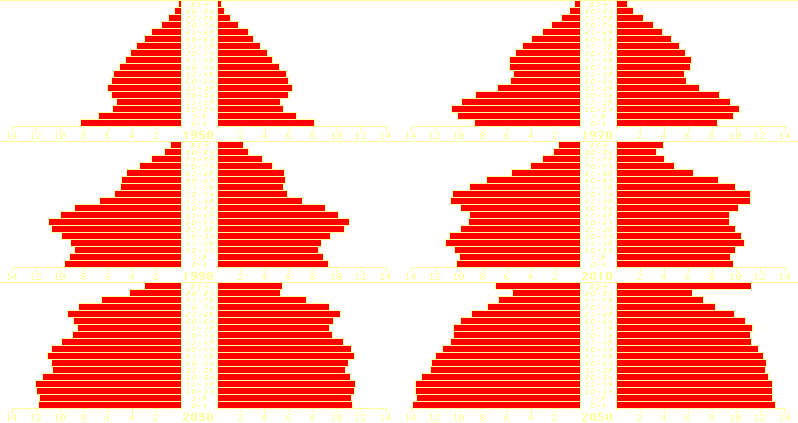
In fact, one should expect to see a pig-in-the-python effect. Look at the graph below, a demographic graph of the United States population, and imagine it on its side.
For some reason I cannot animate it. Please click here to see the chart move.

Imagine the 30 days late are the baby boomers. You can see the large effect [pig] they have as they move from the head to the rear of the distribution [python.] We should see the same for the mortgages. Not a perfect correlation because as I said above there are ways to save yourself from the foreclosure route. But...

Instead what I see is really a throughput problem. Let's look at the graph again with some new arrows.


As you can now see I simplified to just two arrows, 30 days late and 90+ days late. I discounted the seemingly aberrational June month for 30 days late. I then started the arrow for 90+ days late at a lag of 4 months because obviously these mortgages would pick up only after the initial delay in payment. What is happening is that the 30 and 60 day loans are making it to 90+ days and then sitting there. Slowly, the foreclosure and REO process is picking up but those two steps are slowing the assembly line down.

So the key issue for investors to consider is the plus. If you are going out an looking for a house right now, you must be cognizant that the banks own tons of houses that are in the 90+ day delinquent status and would be foreclosed upon except the banks do not have the manpower or willpower to further the process. Additionally the 30 day late loans are still rising meaning that even more houses have yet to find the pool of 90+ days late. If the house you are looking at has multiple bidders I would walk away, especially if they are bidding with cash.

Wednesday, October 21, 2009

Recovery

David Rosenberg of Gluskin Sheff has been railing against the markets expecting a V-shaped recovery. So I went to the CBO to see what a V-shaped recovery would look like and it is below.


Basically from where we are at we would follow the red arrow and see growth rates of over 6.4% to return the economy back to its trend.

Here is where the document is a little suspect as it predicts the return to trend within 5 years which seems to be, um, a tad, convenient. I guess my argument would be more with the angle of the L.

Regardless, the CBO still sees an L-shaped recovery.

So what does the equity market know from reading the economic reports that the CBO does not know?

Personal Savings Rate

I have found it an amusing example of not seeing the forest from the trees. I have heard pundits arguing about where the personal savings rate will move from here. Then I see a chart similar to this proposed.


So it is easy to see that savings rate has jumped but will probably be back to trend soon. However, what trend is probably the most relevant idea. Here is a second chart.


So which is it? A trend of savings around in the 4% range or is it in the high single digits?

Public Relations: the Conclusion

I must say that I really enjoyed the documentary and you can watch it for free courtesy of Google. [The related videos will lead you through the four parts] The question though is how is this seemingly anthropological look at public relations relevant today? For this I will outsource to David Einhorn writing in his investment newsletter. [It is a PDF]

As I see it, there are two basic problems in how we have designed our government. The first is that officials favor policies with short-term impact over those in our long-term interest because they need to be popular while they are in office and they want to be re- elected. In recent times, opinion tracking polls, the immediate reactions of focus groups, the 24/7 news cycle, the constant campaign, and the moment-to-moment obsession with the Dow Jones Industrial Average have magnified the political pressures to favor short-term solutions. Earlier this year, the political topic du jour was to debate whether the stimulus was working, before it had even been spent.

Paul Volcker was an unusual public official because he was willing to make unpopular
decisions in the early ’80s and was disliked at the time. History, though, judges him kindly for the era of prosperity that followed.

Presently, Ben Bernanke and Tim Geithner have become the quintessential short-term
decision makers. They explicitly “do whatever it takes” to “solve one problem at a time” and deal with the unintended consequences later. It is too soon for history to evaluate their work, because there hasn’t been time for the unintended consequences of the “do whatever it takes” decision-making to materialize.

The second weakness in our government is “concentrated benefit versus diffuse harm”
also known as the problem of special interests. Decision makers help small groups who care about narrow issues and whose “special interests” invest substantial resources to be better heard through lobbying, public relations and campaign support. The special interests benefit while the associated costs and consequences are spread broadly through the rest of the population. With individuals bearing a comparatively small extra burden, they are less motivated or able to fight in Washington.

David has in four short paragraphs perfectly surmised what it took me 4 separate blog postings. I will concede, I dug further into the psychology of the transmission mechanism of psychoanlaysis being applied to the link between product and consumers and how it has evolved over time not only in that link but how politicians now use the same mechanism to connect politics[product] to voters [consumers.]

On a regular basis I read financial news and am incensed by how it is spun. I talk at length with former business school professors and we vent together. However, when I talk to some one like a parent or a colleague in the law profession, I only receive glazed over eyes.

There are two factors at work: A) information overload B) esoteric nature of the finance industry.

I have already posted at length about information overload. My money quote that I keep chanting in a mantra is: it was Herbert Simon though who posited a long time ago "...in an information-rich world, the wealth of information means a dearth of something else: a scarcity of whatever it is that information consumes. What information consumes is rather obvious: it consumes the attention of its recipients. Hence a wealth of information creates a poverty of attention and a need to allocate that attention efficiently among the overabundance of information sources that might consume it..." This is very similar to the idea that by reducing people to desires you can stop them from thinking about how policies are affecting them. Dancing with the Stars, 30Rock, Celebrity news all stop people from thinking about how they just donated 2,300 to Government Sachs and its colleagues to pay out, at Goldman alone, 23 Billion to its employees.

The esoteric nature of finance. So any normal Joe who did not graduate with a finance degree, MBA or an economics degree, is involved in her every day life that revolves not around finance, but what ever it is that pays the bills. Everyone can have an opinion on whether on not to raise taxes, or pursue certain domestic policies but not everyone will have an opinion on Negative Amortizing Interest Only Mortgages, or Collateralized Debt Obligations.

Thus, my hope is that my new arsenal of information on public relations and spin that I will be able to better engage my non-finance friends and family to better explain why the issues are important to everyone not just the people with vested interests in finance and financial policy.

Call it for what it is. It has more names than Satan. Call it plundering. Call it pillaging. Call it extortion, Call it fraud. Call it racketeering. Call it the financial raping of the middle class. Call it criminal. Consider the following. Middle class never consented to this financial rape. They vehemently protested it when the gov’t first proposed a $700 bailout of the financial system called TARP in Septermber 2008. Yet what did Congress and our government do? They went ahead and did it anyway. This boils down to one thing, taxation without representation. Our votes do not matter anymore.

Be outraged. Do not go softly into the night. Scream into the tempest. People voted in Obama for change, if you feel he has not effected it, then you must create your own.

The Waning Threat of Deflation versus Two Easy-Money Pieces

I swear I had to read the latest James C Cooper piece in BusinessWeek twice just to be sure what I was reading. So I thought about doing a comparison to various academics and their current surveys of economic conditions, one was Paul Krugman's latest piece. This would provide a look to see where consensus was and where it was not, so I could gauge which argument(s) I found to have a more solid foundation.

James, an
alumnus from NC State where he received his bachelors and masters degree, shows that Personal Consumption Expenditures declined from a year ago by 0.5% or 0.0005. He attributes most of this to the drop in gasoline prices. Here is the table from the BEA release.

Click to enlarge

As you can read from the chart his argument is correct. The index declined 23.7% in the energy good/services subcategory in the same time period.

However, now we can contrast this with Mr. Krugman's, with a BA from Yale in Economics followed by a PHD in Economics from MIT, evidence. He looks at the similar indicator formed from the Consumer Price Index. It also has a total value and one excluding energy and food prices because of their noted volatility. However, in this version instead of removing food and energy totally, he chooses to trim the data, that is remove the most volatile price movements to get to a "core" price movement. Here is the chart.


Click to enlarge

Here we can see the quarterly data from the 1st and 2nd quarter plus the data from September. So you can see the total annualized CPI for the three periods, in order, are: 1.5%, 3.3% and 2.0%. However, if you trim out the volatile prices, depending on the amount trimmed you usually what is basically a horizontal asymptote and those are: 2.3%, 1.0% and 0.5%, a clear downward trend. In fact if you look at James's chart it shows the same information, that both core and the more volatile are in a downward trend. So we have to separate pieces of data that suggest inflation will not be a concern moving forward.


The title of the chart even states in full caps CORE INFLATION WILL CONTINUE TO DRIFT LOWER. So rationally you could think that Mr Cooper and Mr Krugman are on the same page.
"This suggests that disinflation is proceeding rapidly. And a falling inflation rate, possibly even deflation, means that a zero interest rate is less expansionary than it seems."

James, however, entitles his piece The Waning Threat of Deflation?!?!

It seems to me and anyone looking at these charts that are provided as evidence that deflation is on its way.

James bases his assertion on a few observations: inventories may have been cut too deeply along with capital spending (investment) and payrolls. He argues that inventory restocking, the actual fall of capital stock which affects the denominator in capacity utilization therefore utilization rates could increase faster in a recovery, and the fact that 6% productivity is unsustainable, thus new employees will need to be added. I would argue that the latter is the most important in James's arsenal as Consumption provides 70% of GDP, however a person cannot be a consumer without a job.

Luckily, just this morning I was reading a post by James Hamilton, a PHD and Masters in Economics from UC-Berkley, about unemployment and inflation. He found that by running a model of two year average of inflation and inflation expectation he could arrive at a very high correlation. Here is his chart.
Click to enlarge

His chart shows that inflation is still falling off a cliff and until unemployment turns, not just the stemming of jobless claims but actual growth of jobs that inflation will continue to fall. From his words,
"but the forecast of the model for the average inflation rate between 2009:Q4 and 2011:Q4 is -0.5%." Again reiterating that without jobs no growth of GDP is sustainable, thus no inflation.

Finally, there is my new favorite graph. Median Duration of Unemployment. That is to say unemployment is not a bad thing per se, there is a natural creative destruction as employees from a dying industry like paper sales move to a more dynamic industry like alternative energy or health care. Unemployment is bad however when the economy cannot quickly move applicable skill sets, like sales of paper to sales of solar panels. Both require knowledge of a product and industry so they should be quick substitutes but when the economy is not doing this task people stay unemployed for long bouts of time. This, of course, impinges on growth. Let us see what the current outlook looks like.


Highest ever since it has been tracked.

The Fed has to act as training wheels for the US economy. It must support and guide the economy into growth but even as growth resumes it must not remove it stimulus too soon or relapse will occur. I do not believe Bernanke will remove stimulus until unemployment falls below 7%.

So in conclusion, I am not certain what James's article is about at all. He states that inflation will allow the Fed leeway to raise rates but does not specify how inflation will be brought about except for plausible stories without an econometric model to show how inflation will be transmitted. Merely stating that an inventory build or utilization rate climbing by decreasing the stock of capital does not guarantee sustainable growth based on an organic recovery. One of the major lessons for Bernanke as a student of the Depression was that the removal of stimulus in 1936 and 1937 caused the economy to crash in 1938. Then again James was the chief economist of the American Forest and Paper Association.

Tuesday, October 20, 2009

Public Realtions Part IV

I thought I might piece together parts III and IV but when I reviewed my notes Part IV is the largest by far. There is a lot of ground to cover to reach the conclusion. I will also do one last post on how these ideas are affecting society today.

The most salient point from the previous post is that, "the most important thing in anyone and everyone's lives was to be fulfilled and that was all that really mattered."Of course, it was the job of capitalism to foster the fulfillment of its consumers. If we remember back to the original post though it was understood that this was merely a function of social control. Where this process takes an even more dangerous turn, and a suboptimal one at that, is when politicians use these same psychoanalytical techniques to run their campaigns.

There is a great segment when septuagenarian Edward Bernays appears on the David Letterman show and states people will believe me more if you call me doctor. Bernays initial ideas were that it was good to reach out and stroke the deep emotional yearnings of individuals to make them more confident, powerful and fearful so that they may be controlled.

Now in Great Britain Matthew Freud gave public relations a make over and it became glamorous. Mr Freud was able to engage in very similar activities that Bernays pioneered in the inter-war period. He worked to place ads in interviews with celebrities and also by "purchasing" the editorial pages of the press. The press was outraged and thought this was a corruption of their profession, but still the pages of the editorial sections were filled with pictures of products and specific mentions of the product in the text. It was a part of a sweeping changing in the UK to allow business to take over the role of government in fulfilling the needs of the people and was seen as a new and better democratic process.

Across the pond in America, Reagan was moving against against the government's role in fulfilling its people's need by targeting programs to support welfare. His pitch was that individuals did not need to throw their hard earned money away to people who did not want to work.

Both of these are examples of how focus groups were changing the game for politicians. It was now accepted that people did like to be a part of groups but also retained their individual characteristics. This individual had been trained by Corporate America to make demands for their hard earned dollars. Now with their votes these same consumers could, as they did with business, make politicians cater to their demands. The 1980s was leaving the left side of the political spectrum behind as the left's focus had always been on bettering society for all. In a very similar fashion to what Stanford Research Institute proclaimed the left in Britain was polling well on helping save the community. People openly stated in polls that they would vote for the left. Yet their self interests lay with the proposals that the conservatives were making. Ultimately, as predicted, the conservatives were with whom the voters cast their lot.

Then came the Clinton campaign. The campaign made extensive use of polling of swing voters and tailoring their message to fit their beliefs. The campaign found that voters only wished to support taxes for programs that personally benefited them, so the campaign responded with a middle class tax cut promise. This promise was going to be funded by cutting defense spending (the peace dividend) and raising taxes on the rich. Clinton won election in 1992. However, he quickly found out that the budget deficit was worse than feared and the bond market would not support additional borrowing to fund the tax cuts. The stymied executive office instead tried a new tact to lift the public by appeals to genuine ideals of society and community. Needless to say, the voters felt betrayed. In 1994 Bill Clinton's party was swept out of office in the both houses of the legislature, who ran on a platform of tax cuts funded by cutting welfare programs via the Welfare-to-Work initiative. It seemed certain that Clinton would be a one term president.

Clinton hired Dick Morris to save his "butt." Dick proposed that a transformation of politics needed to be undertaken and to treat voters like consumers, answering to their whims and fulfilling them. Surveys were sent out to identify swing voters and then personal questions were asked of the swing voters to determine their lifestyle. Policies were then enacted that would make the swing voters feel more secure in their lifestyle via "small bore" politics. Traditional issues were dropped in favor of minutiae like the v-chip or school uniforms. Also Clinton's leisure time would be spent doing activities that appealed to swing voters such as hunting or fixing up his home. This created a divide between Clinton's wonks and Dick Morris.

The wonk's argument in the White House went something like this:

What's the point if you have no mandate to be re-elected?

What's the point of having a mandate if you cannot get re-elected? Isn't the point getting re-elected?

In a show of deference to power, suburbanites were now controlling the domestic policy of the United States. However, it should be noted that this new form of democracy was pandering to the unthought about and primitive desires that satisfy individuals. It was discussed before that having people's desires be in control is not the same as having rational people in control. That this is just a guise to control the masses via their own whims.

Britain followed suit with the Tony Blair campaign. The feeling in the UK at the time was now that individuals were not exploited by the free market. Instead that the free market caters to individuals and fulfills their needs. However, this also hollows out the political channel as a means of power and leaves a larger slice of power in the hands of businesses and entrenched interests. Bernays proclaimed in his Democra-city that this new form of democracy was superior because the power was not swayed by politics or ideologies. The argument against this idea was that this was a democracy that controlled its citizens by reducing its active citizenry into passive consumers who are delivered "feel-good" treats.

It should also be noted that what works for business may not be the best manner to conduct political actions. Politics can now be described as a bewildering maze of desires because people's opinion changes at the drop of a hat just like in business, "the (product) market had forever changed from needs-based to a market of unlimited and ever changing desires."Fine, that is why there is Adidas, Reebox, New Balance, Nike, etc. However, for politicians there is no way to plan an agenda because the dynamic changes drastically and schizophrenically. An example of this was the railroads in Great Britain. During a campaign people were polled as to how important this issue was to them. The answer was not at all. Now after a series of accidents, delays and poorer service the politicians are being blamed for not investing sooner.

So instead of having an honest conversation people only want more public services and to pay less. There is no leadership where a politician can say, "Here are my beliefs, we should cut this service and I will cut taxes that fund this service. I pledge to do this wisely and judiciously. If you believe in this idea and in me, than you should vote for me." Or the converse, "We should offer this service to you and people like you in the community and it will cost more in taxes to do so. I pledge to use the money wisely to achieve these ends. If you believe in this idea and in me, than I should have your vote." However, what the political system is instead producing is a fear of having a rational discussion with the masses about a politician's coherent political opinion.

The final plea of the program is for individuals to think beyond themselves and how they have been trained by business. That people are more than "feel-good" machines and not slaves to their desires. If we are these things and cannot move beyond these ideas then it would be best to dissolve the government and allow businesses to sate our desires. As individuals move away from their consumer side, politicians will have to engage them with a rational deliberation that respects the individuals abilities to form rational opinions on what is best for society.